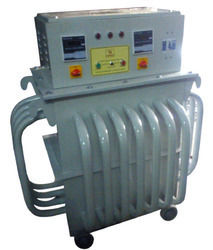
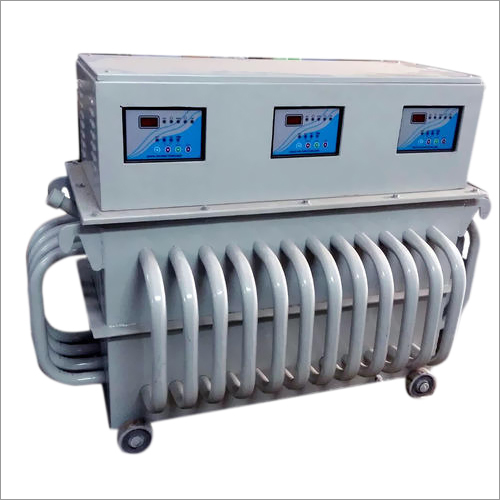
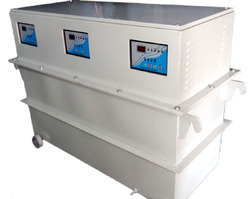
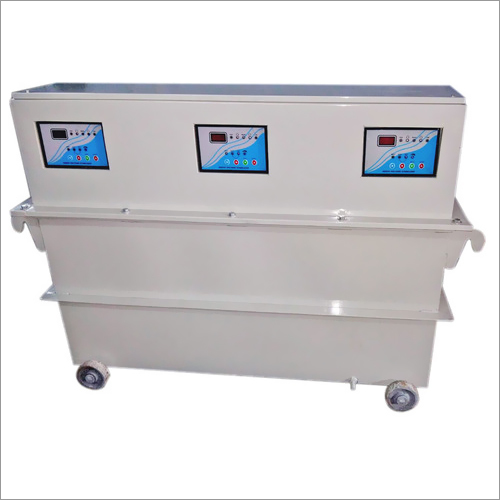
About Three Phase Oil Cooled Servo Voltage Stabilizers
Product Details
| Working Temperature | 1 |
| Input Voltage | 300v-470v |
| Type | Manual,Semi-automatic,Automatic |
| Phase | Three Phase |
| Power | 120KVA |
| Output Voltage | 415v |
| Automatic Grade | Servo |
| Body Material | M.S |
| Control Type | Digital controller |
| Cooling Type | Oil cooled |
| Insulation | 1 |
| Color | Grey |
| Size | 1 |
| Oil Quantity | 1 |
| Response Time | 1 |
Advanced Protection and SafetyOur stabilizers are equipped with comprehensive protection features, including short circuit, over/under voltage protection, and negligible waveform distortion. High-grade insulating oil cooling and super enameled copper windings guarantee efficient heat dissipation and durability, even in demanding environments. This reliable design helps safeguard your sensitive machinery against voltage variations and unpredictable power conditions.
Customizable and Versatile SolutionsEvery installation has unique requirements, and our servo voltage stabilizers cater to that need by offering customizable load capacities, diverse floor-mounted dimensions, and both indoor and outdoor mounting capabilities. The robust powder-coated metal enclosure adds another layer of protection, while multiple terminal strip options ensure flexible connectivity for various industrial and commercial applications.
User-Friendly Operation and MaintenanceFeaturing a clear digital meter display and automatic servo control, our voltage stabilizers assure quick responses (<25 ms) and precise regulation accuracy. Easy-access maintenance panels and adherence to rigorous industry standards provide peace of mind during both operation and servicing, ensuring minimal downtime and maximum reliability for users.
FAQs of Three Phase Oil Cooled Servo Voltage Stabilizers:
Q: How does a Three Phase Oil Cooled Servo Voltage Stabilizer regulate voltage fluctuations?
A: The stabilizer uses an automatic servo control system and a servo motor to continuously adjust the transformer output, ensuring that the output voltage remains at 415V 1% AC even as input voltages swing from 340 to 470V. This real-time regulation protects electrical equipment and extends its operational life.
Q: What are the main benefits of using an oil cooled, floor-mounted stabilizer in industrial or commercial settings?
A: Oil cooled stabilizers efficiently dissipate heat with high-grade insulating oil, enabling continuous heavy-duty operation. The floor-mounted, rugged design provides stability, while advanced protection features (like short-circuit and over/under voltage protection) ensure reliable, safe performance under various load conditions.
Q: When should I consider installing a three phase voltage stabilizer for my business?
A: It is recommended to install a voltage stabilizer when your facility experiences frequent voltage fluctuations or unreliable supply, or if you operate sensitive equipment susceptible to even minor power variations. Using a stabilizer prevents equipment damage and costly downtime.
Q: Where can these stabilizers be installed and what are the mounting options?
A: These stabilizers are designed for both indoor and outdoor installation, thanks to their versatile, weather-resistant powder-coated enclosure and robust construction. They are primarily floor-mounted and available in multiple dimensions to accommodate different spatial requirements.
Q: What is the process for selecting the right stabilizer model for my load requirements?
A: To choose the correct stabilizer, assess your maximum load (in kVA or current), desired input voltage range, and installation conditions. Custom load capacities and dimensions are available, so consulting with the supplier or manufacturer ensures a unit tailored to your specific operational needs.
Q: How is maintenance conducted and what features support easy serviceability?
A: Maintenance is straightforward due to easy access panels designed for quick inspection and servicing. The high insulation resistance (>5 Mega Ohms at 500V DC) and digital meter display allow for simplified monitoring and diagnostics, reducing service time and minimizing system interruptions.